Walk into any furniture showroom and the two panels can look identical, because both are often wrapped in the same laminate. The real difference is hidden in the core, and that core decides how a hinge holds, how a shelf sags and how a cabinet reacts to a spill. This guide compares plywood and particle board by structure, performance and use, with practical notes from what we see in buyer inquiries at Yufu.
What Is Plywood and What Is Particle Board?
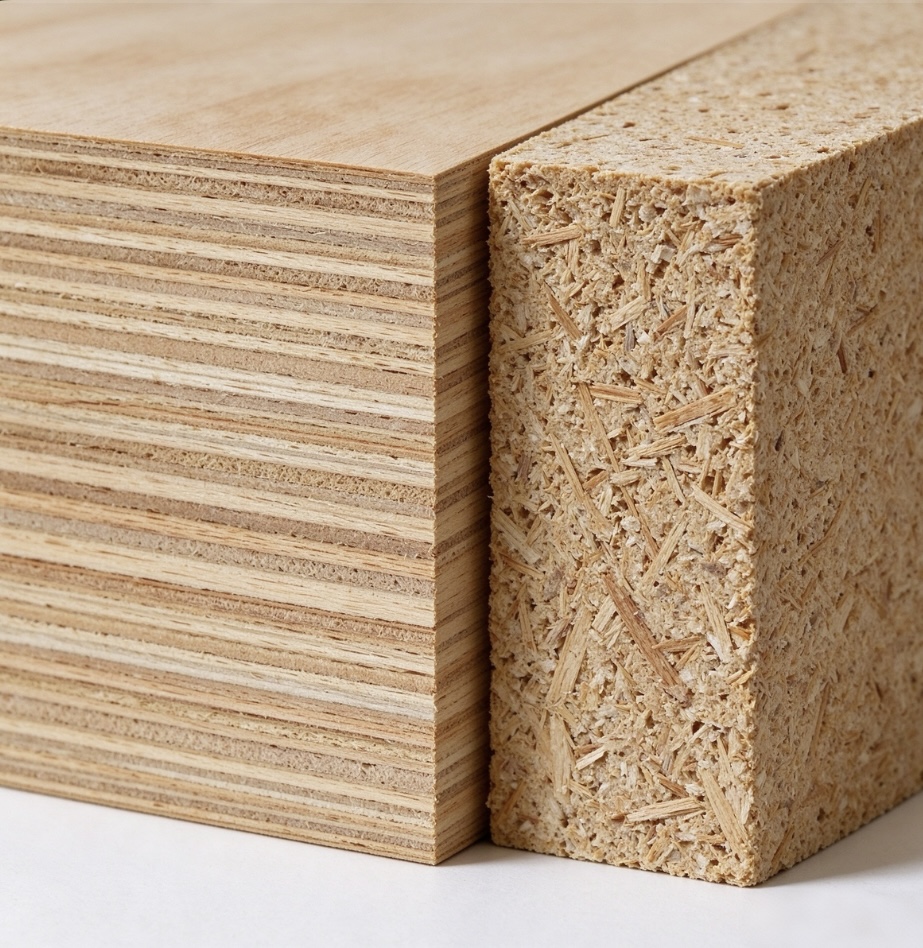
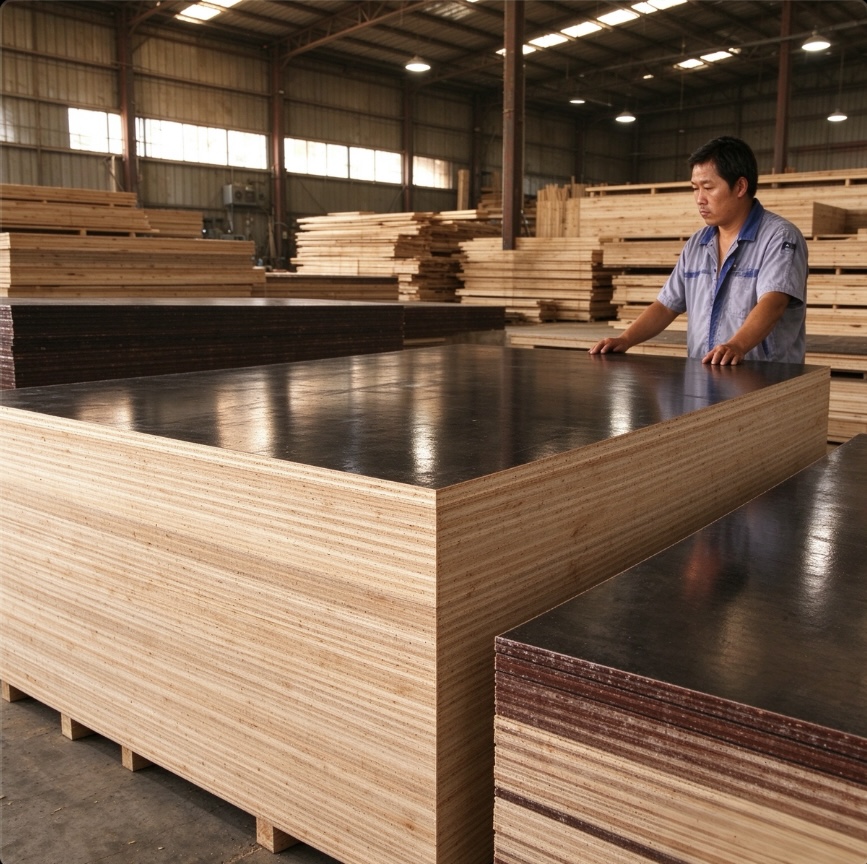
Plywood is made of thin wood veneers glued with alternating grain direction, and that cross‑grain structure is what gives it strength and screw‑holding power, as Cabinet IQ notes. Particle board is built differently. According to the USDA Forest Products Laboratory, it is a panel made from dry wood particles such as sawdust and planer shavings, bonded with resin. One is a stack of real veneer, and the other is compressed wood fragments.
How Are Plywood and Particle Board Manufactured?
Plywood production peels logs into veneer, glues the sheets in odd‑numbered layers and hot‑presses them. Particle board starts from smaller pieces, which are mixed with adhesive and pressed under heat. Many boards use three layers, and Designing Buildings describes a core pressed at around 600 kg/m³ between faces of roughly 700 to 800 kg/m³ with more binder. The USDA report adds that grades are separated into high, medium and low density classes, and this matters in practice: a high‑density furniture board is a very different product from a low‑density one, even if both are called particle board.
Plywood vs Particle Board: Key Differences
Strength and fastener behavior are where the two diverge most. Woodworking Network lists low load capacity, weak conventional fasteners, expansion in humid conditions and edges that need extra treatment as the main limits of particleboard. Cabinet IQ points out that swelling tends to start at edges, cutouts and screw holes, and that the damage can become permanent. It also admits a fair point: a thick, high‑density furniture board can beat a thin budget plywood panel, so the label alone does not settle the question.
| Factor | Plywood | Particle Board |
|---|---|---|
| Core structure | Cross‑grain veneer layers | Resin‑bonded wood particles |
| Screw holding | Strong, even near edges | Weaker, depends on density grade |
| Moisture response | Tolerates minor wetting | Swells, often permanently |
| Surface | Veneer or film faced | Smooth, ideal for laminate |
| Best zones | Sink bases, load‑bearing frames | Dry uppers, closet systems |
Regulation also touches both products. EPA's TSCA Title VI rule sets formaldehyde limits for hardwood plywood and particleboard alike, at 0.05 ppm and 0.09 ppm respectively. Buyers exporting finished furniture to the U.S. should check labeling for either core.
Which Material Is Better for Cabinets and Furniture?
Neither wins everywhere. JourneymanHQ reports that many professionals use plywood for the sink base and cabinets near the dishwasher, and melamine‑faced board for upper cabinets and dry pantries. We agree with this zone‑based approach. In our experience, failures start where water and load meet: a bottom edge touching a wet floor, a hinge screw in a heavy door, or a cutout around plumbing. If those spots are protected with edge banding or sealing, a good‑density melamine board performs well in dry rooms. Where they cannot be protected, plywood is the safer core.
How to Choose the Right Board for Your Project
Judge the core and the face separately. A melamine surface makes any board easy to clean, but it does not change what sits underneath, so ask for the core type, the density grade and the edge treatment. Then match the board to the zone: plywood for wet or heavily loaded parts, and particle board for dry, lightly loaded panels where cost matters.
If you want a middle path, look at melamine‑faced products with stronger cores. At Yufu, buyers who like a laminated finish often compare Melamine Faced Plywood, which suits wet or load‑bearing parts, with Melamine Faced Blockboard, which suits wide shelves and door panels where lighter weight helps. Choosing the core first and the finish second keeps the specification honest.
Conclusion
Plywood offers better screw holding and moisture tolerance, while particle board offers a smooth surface and lower cost. The best choice depends on where the panel will live, how much load it carries and how well its edges are protected. Decide the core by the zone, then pick the finish you like.
Reference
- Cabinet IQ – Plywood vs Particle Board Cabinets: Which Is Actually Better?
- USDA Forest Products Laboratory – Wood Particleboard and Flakeboard: Types, Grades, and Uses
- Designing Buildings – Three‑layer Particle Board
- Woodworking Network – Panel Principles: Particleboard
- Federal Register (EPA) – Formaldehyde Emission Standards for Composite Wood Products
- JourneymanHQ – Melamine vs Plywood Cabinet Boxes: Which One Should You Use for Durability?